

- Market Size (2026)
- USD 23.72 Bn
- Forecast (2036)
- USD 45.80 Bn
- CAGR (2026 to 2036)
- 6.8%
Ergonomic Furniture Market Size, Market Forecast and Outlook By FMI
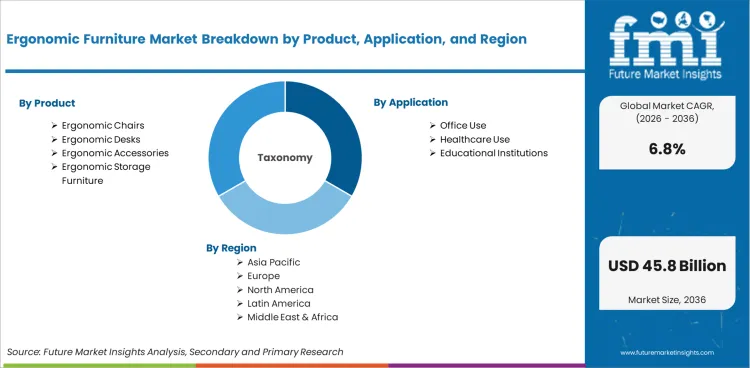
The ergonomic furniture market was valued at USD 22.2 billion in 2025. The market is set to reach USD 23.7 billion by 2026-end and grow at a CAGR of 6.8% between 2026-2036 to reach USD 45.8 billion by 2036. Ergonomic Chairs will dominate with a 45.0% share, while Office Use will lead with a 60.0% share.
Summary of the Ergonomic Furniture Market
- Demand and Growth Drivers
- Corporate workplace wellness programs and occupational health regulations are mandating ergonomic furniture procurement in commercial office environments, creating structured institutional demand pipelines.
- Remote and hybrid work models sustained after the pandemic are expanding residential demand for height-adjustable desks and ergonomic chairs as home office investment becomes a recurring budget category.
- Standing desk and sit-stand workstation adoption is the fastest-growing product sub-category, supported by clinical evidence linking prolonged sitting with musculoskeletal and cardiovascular health risks.
- Product and Segment View
- Ergonomic Chairs is projected to remain the dominant product segment with a 45% share, supported by established demand and procurement patterns.
- Office Use is expected to hold around 60% of application segment as per buyer preference and usage pattern.
- Commercial is expected to hold the major share of 65% in the end use segment during the forecast period.
- Geography and Competitive Outlook
- India is likely to remain a key market at 9.3% CAGR, supported by strong demand fundamentals and expanding adoption.
- Canada is likely to sustain growth at 7.8% CAGR owing to rising spending and expanding infrastructure.
- Companies with broad product portfolios and multi-channel distribution are likely to gain traction during the forecast period.
- Analyst Opinion
- The ergonomic furniture market is evolving into a more defined commercial category with clear segment leaders and established distribution patterns.
- Adoption is increasing due to rising consumer awareness, expanding retail infrastructure, and growing influence of specialized channels on purchase behavior.
- Demand is also supported by premiumization trends, with buyers trading up to higher quality products with functional differentiation.
- Companies that can improve cost competitiveness while delivering consistent quality across key segments are likely to strengthen their position over the forecast period.
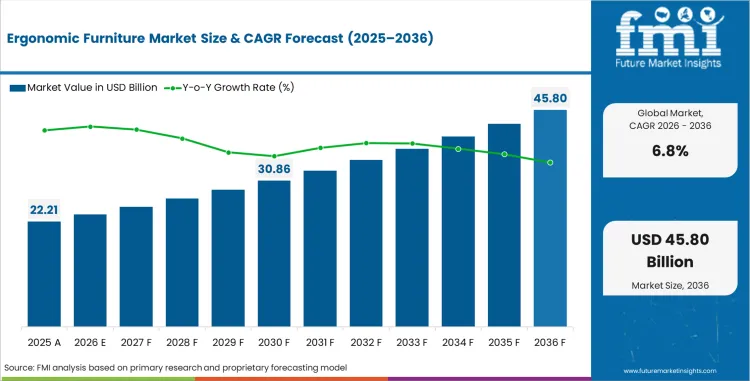
Key Takeaways, Market Size, and Forecast
- The ergonomic furniture market was valued at USD 22.21 billion in 2025.
- By 2036, the Ergonomic Furniture Market is expected to be worth USD 45.8 billion.
- From 2026 to 2036, the market is projected to expand at a CAGR of 6.8%.
- The market is projected to create an incremental opportunity of USD 22.08 billion between 2026 and 2036.
- In 2026, ergonomic chairs is expected to account for 45% of the product segment, driven by demand for adjustable task chairs and executive seating in corporate office and remote work environments.
- India (9.3%) and Canada (7.8%) are two of the fastest growing markets in the world.
Ergonomic Furniture Market Definition
The ergonomic furniture market encompasses commercially traded furniture products designed to support correct posture, reduce musculoskeletal strain, and improve comfort in workplace and residential settings. Product categories include ergonomic chairs, ergonomic desks, ergonomic accessories, and ergonomic storage furniture manufactured using metal, wood, and plastic composite materials.
Ergonomic Furniture Market Inclusions
Market scope covers all commercially traded ergonomic furniture products categorized by product (ergonomic chairs, ergonomic desks, ergonomic accessories, ergonomic storage furniture), application (office use, healthcare use, educational institutions), end use (commercial, residential), distribution channel (offline retail, online retail), material (metal based furniture, wood based furniture, plastic and composite), and pricing tier (mid range, economy, premium). The revenue range spans from 2026 to 2036.
Ergonomic Furniture Market Exclusions
The scope does not include standard non-ergonomic office furniture, industrial workstation equipment, or automotive seating systems.
Ergonomic Furniture Market Research Methodology
- Primary Research: FMI analysts engaged with commercial furniture manufacturers, corporate facilities managers, workplace design consultants, and furniture retail buyers across key markets.
- Desk Research: Using data from furniture industry associations, workplace health organisations and corporate procurement databases.
- Market sizing and forecast: Bottom up approach by product categories, end user segments and distribution channel, with regional adoption curves calibrated by density of corporate offices and penetration of remote work.
- Data validation: We cross checked quarterly against commercial furniture shipment data and manufacturer disclosures.
Why is the Ergonomic Furniture Market Growing?
- Corporate workplace wellness programs and occupational health regulations are mandating the procurement of ergonomic furniture in commercial office environments, thus creating structured institutional demand pipelines.
- Home office investment is becoming a recurring budget category thanks to remote and hybrid work models that have continued post-pandemic. As a result, height-adjustable desks and ergonomic chairs are gaining traction in residential demand.
- The fastest growing product sub-category is the adoption of standing desk and sit-stand workstation, owing to clinical evidence linking prolonged sitting with musculoskeletal and cardiovascular health risks.
Ergonomic furniture is a growing market, as workplace wellness mandates and hybrid work models continue to drive demand across the commercial and residential segments. Adjustable task chairs and executive chairs are the main products, with ergonomic chairs accounting for 45.0% of the product segment. 60.0% of application demand is for office use. The biggest consumers of application demand in the office are corporate offices, conference rooms and home offices.
Demand Share Commercial end users constitute 65.0% demand share. Institutional procurement decisions are made by corporate enterprises, healthcare facilities, and educational institutions. Offline retail leads in distribution at 55.0% with furniture showrooms and brand-exclusive stores serving commercial buyers who need to evaluate products physically. Metal-based furniture tops materials (50.0%) with steel and aluminum providing the structural durability needed for daily commercial use.
Market Segmentation Analysis
- Ergonomic Chairs accounts for 45% of the product segment, reflecting established demand patterns.
- Commercial leads the end use segment at 65% share.
The ergonomic furniture market is segmented by product, application, end use, distribution channel, material, pricing tier.
Insights into the Ergonomic Chairs Product Segment
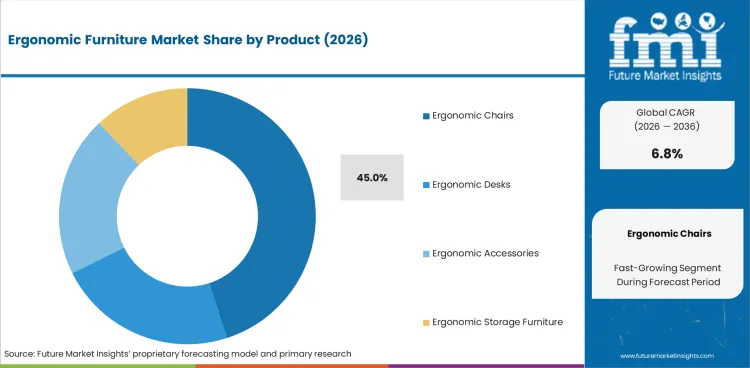
The ergonomic chairs product segment is expected to reach 45.0% in 2026. The most important sub-category of office chairs is adjustable task chairs and executive chairs. Specialty chairs - such as kneeling chairs and saddle chairs - fill niche ergonomic needs. Herman Miller is the leader with a 17.8% share of the market via its Aeron and Embody product lines that set the standards in premium ergonomic seating.
Insights into the Commercial End Use Segment
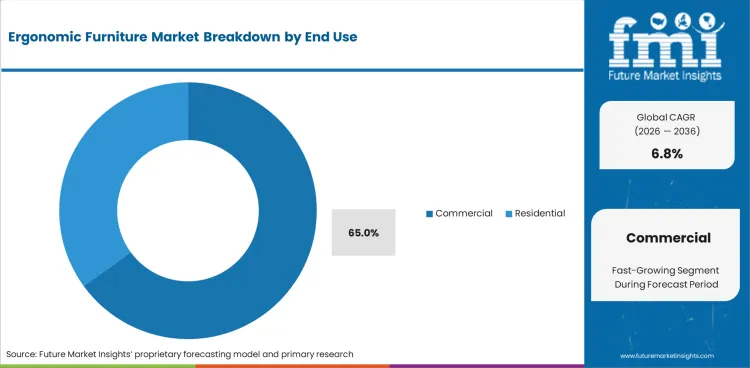
Commercial end users account for 65.0% of demand; Bulk procurement decisions are made by the facilities management departments of corporate enterprises, including the large enterprises as well as the SMEs. Hospitals, clinics and therapy rooms are examples of clinical facilities that require special ergonomic furniture that meets clinical standards. Educational institutions are a growing segment as schools and universities purchase ergonomic classroom and study furniture.
Ergonomic Furniture Market Drivers, Restraints, and Opportunities
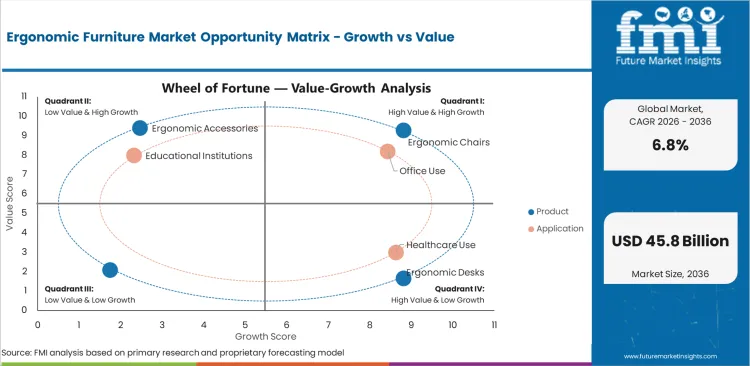
- Corporate Wellness Mandates and is creating targeted demand across key segments.
- High Price Point Barrier is limiting adoption velocity in price sensitive segments
The ergonomic furniture market is shaped by demand-side catalysts and supply-side constraints, which vary by region and price tier.
Corporate Wellness Mandates and Occupational Health
The demand is fueled by corporate wellness programs and occupational health regulations mandating ergonomic workstation configurations. Large companies set predictable institutional volumes of procurement by allocating furniture budgets per employee based on occupational health standards.
Hybrid Work and Home Office Investment
Growth reflects long-term transition to hybrid working models, requiring investment in home office furniture. Companies and their employees are investing in ergonomic home office setups, with height-adjustable desks and ergonomic chairs being the most frequent purchases.
High Price Point Barrier for SME Adoption
Commercial grade ergonomic furniture is a premium cost, so adoption is limited. Small and medium businesses have smaller budgets, so they tend to only look at mid-range or economy options when buying. So premium products don’t get much attention, other than for big corporate customers.
Standing Desk and Sit-Stand Adoption Growth
Height-adjustable and sit-stand desks are increasingly used, spurring growth, supported by clinical evidence that long periods of sitting are associated with health risks. The fastest growing product sub-category is electric standing desks as falling motor costs make them more accessible price-wise.
Analysis of Ergonomic Furniture Market By Key Countries
.webp "Top Country Growth Comparison Ergonomic Furniture Market Cagr (2026 2036)")
| Country | CAGR |
|---|---|
| India | 9.3% |
| Canada | 7.8% |
| Spain | 5.8% |
| Italy | 5.5% |
| UK | 4.7% |
| Germany | 4.4% |
| USA | 4.1% |
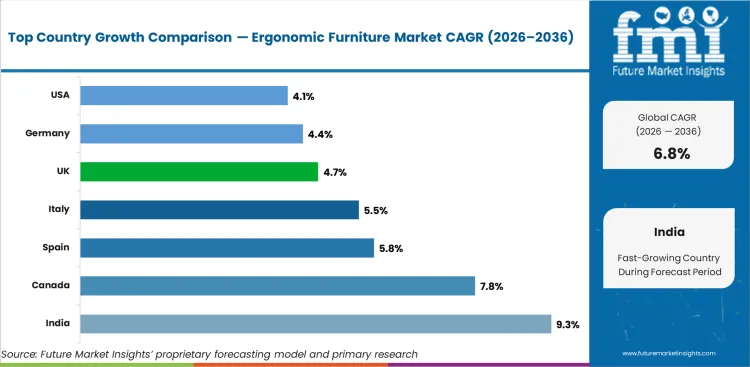
- India is leading with a CAGR of 9.3% on the back of the largest demand base and expanding adoption.
- Canada at 7.8% is a good demand story with more spending and distribution growth.
- Market development continues to drive growth in Spain (5.8%) and Italy (5.5%)..
The global ergonomic furniture market is projected to expand at 6.8% per year from 2026 to 2036. The study covers more than 30 countries.
Sales Analysis of Ergonomic Furniture Market in India
India leads at 9.3% through 2036. Rapid IT sector growth and expanding corporate office infrastructure are generating large-scale institutional procurement demand. PLI scheme incentives for furniture manufacturing and growing awareness of workplace ergonomics support market development.
- IT sector expansion and corporate office growth create large-volume institutional furniture procurement.
- PLI scheme incentives are attracting investment in domestic ergonomic furniture manufacturing.
- Growing workplace ergonomics awareness among Indian corporates is shifting procurement toward ergonomic specifications.
Future Outlook for Ergonomic Furniture Market in Canada
Canada is growing at 7.8% through 2036. Workplace health and safety regulations and strong remote work adoption sustain demand. Canadian employers are investing in home office ergonomic furniture allowances for hybrid workers.
- Workplace health and safety regulations mandate ergonomic workstation configurations in offices.
- Remote work adoption sustains demand for residential ergonomic furniture investment.
- Employer-funded home office allowances are creating new procurement channels.
Demand Outlook for Ergonomic Furniture Market in Spain
Spain is growing at 5.8% through 2036. EU workplace directive compliance and growing co-working space infrastructure support demand. Spanish commercial real estate development is increasingly specifying ergonomic furniture in tenant improvement packages.
- EU workplace health directives drive ergonomic furniture compliance requirements.
- Co-working space infrastructure growth creates institutional procurement demand.
- Commercial real estate tenant improvement specifications increasingly include ergonomic furniture.
In-depth Analysis of Ergonomic Furniture Market in Italy
Italy is expanding at 5.5% through 2036. Italian design and manufacturing heritage in furniture supports premium ergonomic product development. EU workplace regulations and growing corporate attention to employee wellbeing sustain demand.
- Design and manufacturing heritage supports premium ergonomic furniture development.
- EU workplace regulations drive institutional compliance-based procurement.
- Growing corporate attention to employee wellbeing increases ergonomic furniture adoption.
Opportunity Analysis of Ergonomic Furniture Market in the United Kingdom
The UK is growing at 4.7% through 2036. Updated building regulations and workplace health requirements support demand. UK employers are investing in both office and home-based ergonomic furniture as hybrid work policies become standard.
- Updated workplace health requirements mandate ergonomic furniture in commercial offices.
- Hybrid work policies sustain dual-location ergonomic furniture investment by employers.
- Online retail channels are growing as home office furniture purchasing shifts to e-commerce.
In-depth Analysis of Ergonomic Furniture Market in Germany
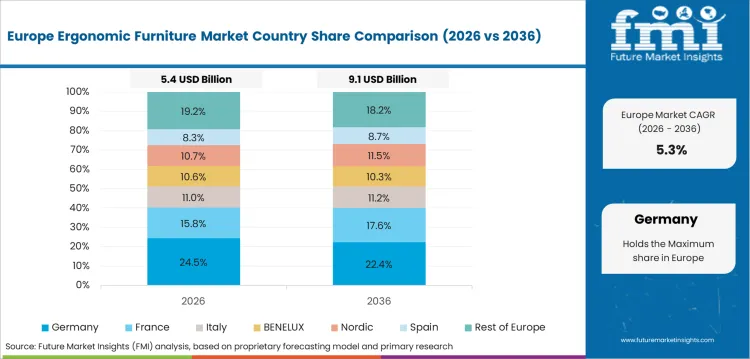
Germany is expanding at 4.4% through 2036. DIN standards for workplace furniture and Industrie 4.0 integration create a structured market. German manufacturers including Vitra and specialized ergonomic brands maintain strong domestic and export positions.
- DIN standards for workplace furniture specifications drive ergonomic compliance requirements.
- Industrie 4.0 integration is advancing smart ergonomic furniture with sensor-based adjustment.
- German manufacturers maintain strong positions through engineering quality and export capability.
Demand Outlook for Ergonomic Furniture Market in the United States
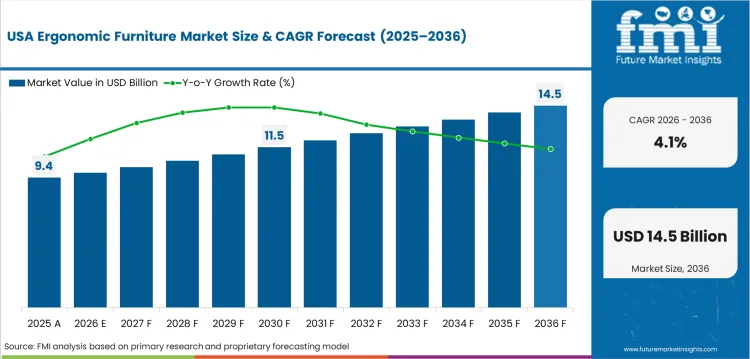
The USA is growing at 4.1% through 2036. Herman Miller, Steelcase, and Haworth dominate institutional procurement. OSHA workplace guidelines and corporate wellness investment sustain commercial demand, while home office spending remains elevated.
- OSHA workplace guidelines support institutional procurement of ergonomic office furniture.
- Herman Miller, Steelcase, and Haworth dominate corporate furniture supply through dealer networks.
- Home office ergonomic furniture spending remains elevated due to hybrid work adoption.
Competitive Landscape and Strategic Positioning
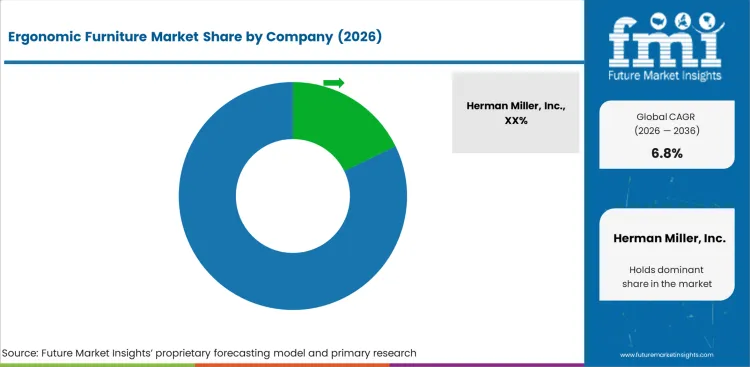
- Herman Miller Inc. is at the forefront with 17.8% market share, with its iconic Aeron and Embody chair lines, full office furniture portfolio and global dealer distribution network that caters to corporate procurement.
- Steelcase Inc. and Haworth Inc. are competitors of similar size, with research-based design, corporate account relationships and full workplace furnishing solutions that include chairs, desks and accessories.
- Humanscale Corporation and Vitra International AG are competing on design-forward ergonomic products that are priced at a premium for architecture and design-led corporate environments.
The competitive landscape is a mixture of global players with broad portfolios and regional players with niche capabilities.
Key Companies in the Ergonomic Furniture Market
Key global companies leading the ergonomic furniture market include:
- Herman Miller Inc. (USA), Steelcase Inc. (USA) and Haworth Inc. (USA) are all market leaders due to their global dealer networks, corporate procurement relationships, comprehensive product portfolios and research-driven ergonomic design.
- Knoll Inc. (USA), Humanscale Corporation (USA) and Vitra International AG (Switzerland) operate in the premium segment with design-led products, architect partnerships and sustainable manufacturing.
- Kokuyo Co.; Okamura Corporation, Japan; Ltd. (Japan) and IKEA (Sweden) compete through regional market strength, value-oriented product line and growing e-commerce distribution capabilities.
Competitive Benchmarking: Ergonomic Furniture Market
| Company | Product Range | Design Innovation | Corporate Access | Price Position |
|---|---|---|---|---|
| Herman Miller | Very High | Very High | Very Strong | Premium |
| Steelcase | Very High | High | Very Strong | Mid to Premium |
| Haworth | High | High | Strong | Mid to Premium |
| Knoll | High | High | Strong | Premium |
| Humanscale | Medium | Very High | Moderate | Premium |
| Vitra | Medium | Very High | Moderate | Premium |
| Okamura | High | High | Strong (Asia) | Mid to Premium |
| IKEA | High | Medium | Strong | Value to Mid |
| Ergotron | Medium | High | Moderate | Mid Range |
| Global Furniture | Medium | Medium | Moderate | Mid Range |
Source: Future Market Insights competitive analysis, 2026.
Key Developments in Ergonomic Furniture Market
- In 2025, Herman Miller launched a new ergonomic task chair designed for hybrid work environments with quick-adjust features for shared workspace use.
- In 2025, Steelcase expanded its height-adjustable desk portfolio with a new electric sit-stand model incorporating wireless charging and cable management systems.
Key Players in the Ergonomic Furniture Market
Major Global Players
- Herman Miller, Inc.
- Steelcase Inc.
- Haworth Inc.
- Knoll, Inc.
- Humanscale Corporation
- Vitra International AG
Emerging Players/Startups
- Global Furniture Group
- Okamura Corporation
- Kokuyo Co., Ltd.
- IKEA
- Flexsteel Industries, Inc.
- HNI Corporation
- Teknion Corporation
- Workrite Ergonomics, LLC
- Ergotron, Inc.
Report Scope and Coverage
| Parameter | Details |
|---|---|
| Quantitative Units | USD 23.72 billion to USD 45.8 billion, at a CAGR of 6.8% |
| Market Definition | The ergonomic furniture market encompasses commercially traded furniture products designed to support correct posture, reduce musculoskeletal strain, and improve comfort in workplace and residential settings. Product categories include ergonomic chairs, ergonomic desks, ergonomic accessories, and ergonomic storage furniture manufactured using metal, wood, and plastic composite materials. |
| Regions Covered | North America, Latin America, Europe, East Asia, South Asia and Pacific, Middle East and Africa |
| Countries Covered | India, Canada, Spain, Italy, UK, Germany, USA, 30 plus countries |
| Key Companies Profiled | Herman Miller, Inc., Steelcase Inc., Haworth Inc., Knoll, Inc., Humanscale Corporation, Vitra International AG, Global Furniture Group, Okamura Corporation, Kokuyo Co., Ltd. |
| Forecast Period | 2026 to 2036 |
| Approach | Hybrid bottom-up and top-down methodology starting with verified transaction data, projecting adoption velocity across segments and regions. |
Market Segmentation Analysis
Ergonomic Furniture Market Segmented by Product:
- Ergonomic Chairs
- Office Chairs
- Adjustable Task Chairs
- Executive Chairs
- Specialty Chairs
- Kneeling Chairs
- Saddle Chairs
- Office Chairs
- Ergonomic Desks
- Height Adjustable Desks
- Electric Standing Desks
- Manual Standing Desks
- Fixed Ergonomic Desks
- Compact Workstations
- Corner Desks
- Height Adjustable Desks
- Ergonomic Accessories
- Keyboard And Mouse Supports
- Wrist Rests
- Adjustable Keyboard Trays
- Monitor Supports
- Monitor Arms
- Laptop Stands
- Keyboard And Mouse Supports
- Ergonomic Storage Furniture
- Adjustable Shelving
- Modular Storage Units
- Height Adjustable Cabinets
- Mobile Storage
- Rolling Cabinets
- Compact Storage Units
- Adjustable Shelving
Ergonomic Furniture Market Segmented by Application:
- Office Use
- Corporate Offices
- Workstations
- Conference Rooms
- Home Offices
- Remote Work Setups
- Freelancer Workspaces
- Corporate Offices
- Healthcare Use
- Hospitals
- Doctor Workstations
- Nurse Stations
- Clinics
- Examination Rooms
- Therapy Rooms
- Hospitals
- Educational Institutions
- Schools
- Classroom Furniture
- Computer Labs
- Universities
- Study Areas
- Research Labs
- Schools
Ergonomic Furniture Market Segmented by End Use:
- Commercial
- Corporate Enterprises
- Large Enterprises
- Small And Medium Enterprises
- Healthcare Facilities
- Hospitals
- Clinics
- Corporate Enterprises
- Residential
- Home Office Users
- Remote Workers
- Students
- Personal Use
- Gaming Setups
- Study Furniture
- Home Office Users
Ergonomic Furniture Market Segmented by Distribution Channel:
- Offline Retail
- Furniture Showrooms
- Brand Exclusive Stores
- Multi Brand Stores
- Specialty Stores
- Office Furniture Stores
- Home Improvement Stores
- Furniture Showrooms
- Online Retail
- E Commerce Platforms
- Third Party Marketplaces
- Brand Owned Websites
- Direct To Consumer
- Online Custom Orders
- Subscription Furniture Models
- E Commerce Platforms
Ergonomic Furniture Market Segmented by Material:
- Metal Based Furniture
- Steel Frames
- Powder Coated Steel
- Stainless Steel
- Aluminum Structures
- Lightweight Frames
- Adjustable Mechanisms
- Steel Frames
- Wood Based Furniture
- Engineered Wood
- Plywood
- Medium Density Fiberboard
- Solid Wood
- Hardwood
- Softwood
- Engineered Wood
- Plastic And Composite
- Polymer Based
- High Density Plastic
- Reinforced Polymers
- Hybrid Materials
- Metal Plastic Combinations
- Wood Composite Structures
- Polymer Based
Ergonomic Furniture Market Segmented by Pricing Tier:
- Mid Range
- Standard Ergonomic Furniture
- Office Grade Products
- Standard Ergonomic Furniture
- Economy
- Basic Ergonomic Products
- Entry Level Furniture
- Basic Ergonomic Products
- Premium
- Advanced Ergonomic Solutions
- Smart Adjustable Furniture
- Designer Furniture
- Advanced Ergonomic Solutions
Ergonomic Furniture Market by Region:
- North America
- USA
- Canada
- Mexico
- Latin America
- Brazil
- Chile
- Rest of Latin America
- Western Europe
- Germany
- UK
- Italy
- Spain
- France
- Nordic
- BENELUX
- Rest of Western Europe
- Eastern Europe
- Russia
- Poland
- Hungary
- Balkan & Baltic
- Rest of Eastern Europe
- East Asia
- China
- Japan
- South Korea
- South Asia and Pacific
- India
- ASEAN
- Australia & New Zealand
- Rest of South Asia and Pacific
- Middle East & Africa
- Kingdom of Saudi Arabia
- Other GCC Countries
- Turkiye
- South Africa
- Other African Union
- Rest of Middle East & Africa
Research Sources and Bibliography
- 1. International Ergonomics Association. (2025). IEA Global Ergonomics and Human Factors Report. IEA.
- 2. Occupational Safety and Health Administration. (2024). OSHA Ergonomic Guidelines for Workplace Design. OSHA.
- 3. European Agency for Safety and Health at Work. (2025). EU-OSHA Report on Workplace Musculoskeletal Disorders. EU-OSHA.
- 4. Business and Institutional Furniture Manufacturers Association. (2025). BIFMA Industry Market Report. BIFMA.
- 5. World Health Organization. (2024). WHO Guidelines on Sedentary Behaviour and Musculoskeletal Health. WHO.
This bibliography is provided for reader reference.
This Report Answers
- Estimating the market size and revenue generation from 2026 to 2036.
- Segmenting by product, application, end use, distribution channel, material, and pricing tier.
- Providing regional insights across more than 30 markets.
- Analyzing corporate procurement and hybrid work demand dynamics.
- Assessing the competitive landscape across chairs, desks, and accessories.
- Identifying investment opportunities in standing desks and smart furniture.
- Tracking material innovation and workplace design trends.
- Delivering data in PDF and Excel formats.
Frequently Asked Questions
How big is the ergonomic furniture market in 2026?
The global ergonomic furniture market is estimated to be valued at USD 23.72 billion in 2026.
What will be the size of ergonomic furniture market in 2036?
The market size for the ergonomic furniture market is projected to reach USD 45.80 billion by 2036.
How much will be the ergonomic furniture market growth between 2026 and 2036?
The ergonomic furniture market is expected to grow at a 6.8% CAGR between 2026 and 2036.
What are the key product types in the ergonomic furniture market?
The key product types in ergonomic furniture market are ergonomic chairs, ergonomic desks, ergonomic accessories and ergonomic storage furniture.
Which application segment is expected to contribute significant share in the ergonomic furniture market in 2026?
In terms of application, office use segment is expected to command 60.0% share in the ergonomic furniture market in 2026.
Preview the report firsthand - request a free sample
Get SampleGet the brochure for pricing and purchase details.
Get PDFTable of Content
- Executive Summary
- Global Market Outlook
- Demand-side Trends
- Supply-side Trends
- Technology Roadmap Analysis
- Analysis and Recommendations
- Market Overview
- Market Coverage / Taxonomy
- Market Definition / Scope / Limitations
- Research Methodology
- Chapter Orientation
- Analytical Lens and Working Hypotheses
- Market Structure, Signals, and Trend Drivers
- Benchmarking and Cross-market Comparability
- Market Sizing, Forecasting, and Opportunity Mapping
- Research Design and Evidence Framework
- Desk Research Programme (Secondary Evidence)
- Company Annual and Sustainability Reports
- Peer-reviewed Journals and Academic Literature
- Corporate Websites, Product Literature, and Technical Notes
- Earnings Decks and Investor Briefings
- Statutory Filings and Regulatory Disclosures
- Technical White Papers and Standards Notes
- Trade Journals, Industry Magazines, and Analyst Briefs
- Conference Proceedings, Webinars, and Seminar Materials
- Government Statistics Portals and Public Data Releases
- Press Releases and Reputable Media Coverage
- Specialist Newsletters and Curated Briefings
- Sector Databases and Reference Repositories
- FMI Internal Proprietary Databases and Historical Market Datasets
- Subscription Datasets and Paid Sources
- Social Channels, Communities, and Digital Listening Inputs
- Additional Desk Sources
- Expert Input and Fieldwork (Primary Evidence)
- Primary Modes
- Qualitative Interviews and Expert Elicitation
- Quantitative Surveys and Structured Data Capture
- Blended Approach
- Why Primary Evidence is Used
- Field Techniques
- Interviews
- Surveys
- Focus Groups
- Observational and In-context Research
- Social and Community Interactions
- Stakeholder Universe Engaged
- C-suite Leaders
- Board Members
- Presidents and Vice Presidents
- R&D and Innovation Heads
- Technical Specialists
- Domain Subject-matter Experts
- Scientists
- Physicians and Other Healthcare Professionals
- Governance, Ethics, and Data Stewardship
- Research Ethics
- Data Integrity and Handling
- Primary Modes
- Tooling, Models, and Reference Databases
- Desk Research Programme (Secondary Evidence)
- Data Engineering and Model Build
- Data Acquisition and Ingestion
- Cleaning, Normalisation, and Verification
- Synthesis, Triangulation, and Analysis
- Quality Assurance and Audit Trail
- Market Background
- Market Dynamics
- Drivers
- Restraints
- Opportunity
- Trends
- Scenario Forecast
- Demand in Optimistic Scenario
- Demand in Likely Scenario
- Demand in Conservative Scenario
- Opportunity Map Analysis
- Product Life Cycle Analysis
- Supply Chain Analysis
- Investment Feasibility Matrix
- Value Chain Analysis
- PESTLE and Porter’s Analysis
- Regulatory Landscape
- Regional Parent Market Outlook
- Production and Consumption Statistics
- Import and Export Statistics
- Market Dynamics
- Global Market Analysis 2021 to 2025 and Forecast, 2026 to 2036
- Historical Market Size Value (USD Million) Analysis, 2021 to 2025
- Current and Future Market Size Value (USD Million) Projections, 2026 to 2036
- Y-o-Y Growth Trend Analysis
- Absolute $ Opportunity Analysis
- Global Market Pricing Analysis 2021 to 2025 and Forecast 2026 to 2036
- Global Market Analysis 2021 to 2025 and Forecast 2026 to 2036, By Product
- Introduction / Key Findings
- Historical Market Size Value (USD Million) Analysis By Product , 2021 to 2025
- Current and Future Market Size Value (USD Million) Analysis and Forecast By Product , 2026 to 2036
- Ergonomic Chairs
- Office Chairs
- Adjustable Task Chairs
- Executive Chairs
- Specialty Chairs
- Kneeling Chairs
- Saddle Chairs
- Ergonomic Desks
- Height Adjustable Desks
- Electric Standing Desks
- Manual Standing Desks
- Fixed Ergonomic Desks
- Compact Workstations
- Ergonomic Accessories
- Keyboard And Mouse Supports
- Wrist Rests
- Adjustable Keyboard Trays
- Monitor Supports
- Monitor Arms
- Ergonomic Storage Furniture
- Adjustable Shelving
- Modular Storage Value (USD Million)s
- Height Adjustable Cabinets
- Mobile Storage
- Rolling Cabinets
- Y-o-Y Growth Trend Analysis By Product , 2021 to 2025
- Absolute $ Opportunity Analysis By Product , 2026 to 2036
- Ergonomic Chairs
- Global Market Analysis 2021 to 2025 and Forecast 2026 to 2036, By Application
- Introduction / Key Findings
- Historical Market Size Value (USD Million) Analysis By Application, 2021 to 2025
- Current and Future Market Size Value (USD Million) Analysis and Forecast By Application, 2026 to 2036
- Office Use
- Corporate Offices
- Workstations
- Conference Rooms
- Home Offices
- Remote Work Setups
- Freelancer Workspaces
- Healthcare Use
- Hospitals
- Doctor Workstations
- Nurse Stations
- Clinics
- Examination Rooms
- Educational Institutions
- Schools
- Classroom Furniture
- Computer Labs
- Universities
- Study Areas
- Office Use
- Y-o-Y Growth Trend Analysis By Application, 2021 to 2025
- Absolute $ Opportunity Analysis By Application, 2026 to 2036
- Global Market Analysis 2021 to 2025 and Forecast 2026 to 2036, By End Use
- Introduction / Key Findings
- Historical Market Size Value (USD Million) Analysis By End Use, 2021 to 2025
- Current and Future Market Size Value (USD Million) Analysis and Forecast By End Use, 2026 to 2036
- Commercial
- Corporate Enterprises
- Large Enterprises
- Small And Medium Enterprises
- Healthcare Facilities
- Hospitals
- Clinics
- Residential
- Home Office Users
- Remote Workers
- Students
- Personal Use
- Gaming Setups
- Commercial
- Y-o-Y Growth Trend Analysis By End Use, 2021 to 2025
- Absolute $ Opportunity Analysis By End Use, 2026 to 2036
- Global Market Analysis 2021 to 2025 and Forecast 2026 to 2036, By Distribution Channel
- Introduction / Key Findings
- Historical Market Size Value (USD Million) Analysis By Distribution Channel, 2021 to 2025
- Current and Future Market Size Value (USD Million) Analysis and Forecast By Distribution Channel, 2026 to 2036
- Offline Retail
- Furniture Showrooms
- Brand Exclusive Stores
- Multi Brand Stores
- Specialty Stores
- Office Furniture Stores
- Home Improvement Stores
- Online Retail
- E Commerce Platforms
- Third Party Marketplaces
- Brand Owned Websites
- Direct To Consumer
- Online Custom Orders
- Offline Retail
- Y-o-Y Growth Trend Analysis By Distribution Channel, 2021 to 2025
- Absolute $ Opportunity Analysis By Distribution Channel, 2026 to 2036
- Global Market Analysis 2021 to 2025 and Forecast 2026 to 2036, By Material
- Introduction / Key Findings
- Historical Market Size Value (USD Million) Analysis By Material, 2021 to 2025
- Current and Future Market Size Value (USD Million) Analysis and Forecast By Material, 2026 to 2036
- Metal Based Furniture
- Steel Frames
- Powder Coated Steel
- Stainless Steel
- Aluminum Structures
- Lightweight Frames
- Adjustable Mechanisms
- Wood Based Furniture
- Engineered Wood
- Plywood
- Medium Density Fiberboard
- Solid Wood
- Hardwood
- Plastic And Composite
- Polymer Based
- High Density Plastic
- Reinforced Polymers
- Hybrid Materials
- Metal Plastic Combinations
- Metal Based Furniture
- Y-o-Y Growth Trend Analysis By Material, 2021 to 2025
- Absolute $ Opportunity Analysis By Material, 2026 to 2036
- Global Market Analysis 2021 to 2025 and Forecast 2026 to 2036, By Pricing Tier
- Introduction / Key Findings
- Historical Market Size Value (USD Million) Analysis By Pricing Tier, 2021 to 2025
- Current and Future Market Size Value (USD Million) Analysis and Forecast By Pricing Tier, 2026 to 2036
- Mid Range
- Standard Ergonomic Furniture
- Office Grade Products
- Economy
- Basic Ergonomic Products
- Entry Level Furniture
- Premium
- Advanced Ergonomic Solutions
- Smart Adjustable Furniture
- Designer Furniture
- Mid Range
- Y-o-Y Growth Trend Analysis By Pricing Tier, 2021 to 2025
- Absolute $ Opportunity Analysis By Pricing Tier, 2026 to 2036
- Global Market Analysis 2021 to 2025 and Forecast 2026 to 2036, By Region
- Introduction
- Historical Market Size Value (USD Million) Analysis By Region, 2021 to 2025
- Current Market Size Value (USD Million) Analysis and Forecast By Region, 2026 to 2036
- North America
- Latin America
- Western Europe
- Eastern Europe
- East Asia
- South Asia and Pacific
- Middle East & Africa
- Market Attractiveness Analysis By Region
- North America Market Analysis 2021 to 2025 and Forecast 2026 to 2036, By Country
- Historical Market Size Value (USD Million) Trend Analysis By Market Taxonomy, 2021 to 2025
- Market Size Value (USD Million) Forecast By Market Taxonomy, 2026 to 2036
- By Country
- USA
- Canada
- Mexico
- By Product
- By Application
- By End Use
- By Distribution Channel
- By Material
- By Pricing Tier
- By Country
- Market Attractiveness Analysis
- By Country
- By Product
- By Application
- By End Use
- By Distribution Channel
- By Material
- By Pricing Tier
- Key Takeaways
- Latin America Market Analysis 2021 to 2025 and Forecast 2026 to 2036, By Country
- Historical Market Size Value (USD Million) Trend Analysis By Market Taxonomy, 2021 to 2025
- Market Size Value (USD Million) Forecast By Market Taxonomy, 2026 to 2036
- By Country
- Brazil
- Chile
- Rest of Latin America
- By Product
- By Application
- By End Use
- By Distribution Channel
- By Material
- By Pricing Tier
- By Country
- Market Attractiveness Analysis
- By Country
- By Product
- By Application
- By End Use
- By Distribution Channel
- By Material
- By Pricing Tier
- Key Takeaways
- Western Europe Market Analysis 2021 to 2025 and Forecast 2026 to 2036, By Country
- Historical Market Size Value (USD Million) Trend Analysis By Market Taxonomy, 2021 to 2025
- Market Size Value (USD Million) Forecast By Market Taxonomy, 2026 to 2036
- By Country
- Germany
- UK
- Italy
- Spain
- France
- Nordic
- BENELUX
- Rest of Western Europe
- By Product
- By Application
- By End Use
- By Distribution Channel
- By Material
- By Pricing Tier
- By Country
- Market Attractiveness Analysis
- By Country
- By Product
- By Application
- By End Use
- By Distribution Channel
- By Material
- By Pricing Tier
- Key Takeaways
- Eastern Europe Market Analysis 2021 to 2025 and Forecast 2026 to 2036, By Country
- Historical Market Size Value (USD Million) Trend Analysis By Market Taxonomy, 2021 to 2025
- Market Size Value (USD Million) Forecast By Market Taxonomy, 2026 to 2036
- By Country
- Russia
- Poland
- Hungary
- Balkan & Baltic
- Rest of Eastern Europe
- By Product
- By Application
- By End Use
- By Distribution Channel
- By Material
- By Pricing Tier
- By Country
- Market Attractiveness Analysis
- By Country
- By Product
- By Application
- By End Use
- By Distribution Channel
- By Material
- By Pricing Tier
- Key Takeaways
- East Asia Market Analysis 2021 to 2025 and Forecast 2026 to 2036, By Country
- Historical Market Size Value (USD Million) Trend Analysis By Market Taxonomy, 2021 to 2025
- Market Size Value (USD Million) Forecast By Market Taxonomy, 2026 to 2036
- By Country
- China
- Japan
- South Korea
- By Product
- By Application
- By End Use
- By Distribution Channel
- By Material
- By Pricing Tier
- By Country
- Market Attractiveness Analysis
- By Country
- By Product
- By Application
- By End Use
- By Distribution Channel
- By Material
- By Pricing Tier
- Key Takeaways
- South Asia and Pacific Market Analysis 2021 to 2025 and Forecast 2026 to 2036, By Country
- Historical Market Size Value (USD Million) Trend Analysis By Market Taxonomy, 2021 to 2025
- Market Size Value (USD Million) Forecast By Market Taxonomy, 2026 to 2036
- By Country
- India
- ASEAN
- Australia & New Zealand
- Rest of South Asia and Pacific
- By Product
- By Application
- By End Use
- By Distribution Channel
- By Material
- By Pricing Tier
- By Country
- Market Attractiveness Analysis
- By Country
- By Product
- By Application
- By End Use
- By Distribution Channel
- By Material
- By Pricing Tier
- Key Takeaways
- Middle East & Africa Market Analysis 2021 to 2025 and Forecast 2026 to 2036, By Country
- Historical Market Size Value (USD Million) Trend Analysis By Market Taxonomy, 2021 to 2025
- Market Size Value (USD Million) Forecast By Market Taxonomy, 2026 to 2036
- By Country
- Kingdom of Saudi Arabia
- Other GCC Countries
- Turkiye
- South Africa
- Other African Union
- Rest of Middle East & Africa
- By Product
- By Application
- By End Use
- By Distribution Channel
- By Material
- By Pricing Tier
- By Country
- Market Attractiveness Analysis
- By Country
- By Product
- By Application
- By End Use
- By Distribution Channel
- By Material
- By Pricing Tier
- Key Takeaways
- Key Countries Market Analysis
- USA
- Pricing Analysis
- Market Share Analysis, 2025
- By Product
- By Application
- By End Use
- By Distribution Channel
- By Material
- By Pricing Tier
- Canada
- Pricing Analysis
- Market Share Analysis, 2025
- By Product
- By Application
- By End Use
- By Distribution Channel
- By Material
- By Pricing Tier
- Mexico
- Pricing Analysis
- Market Share Analysis, 2025
- By Product
- By Application
- By End Use
- By Distribution Channel
- By Material
- By Pricing Tier
- Brazil
- Pricing Analysis
- Market Share Analysis, 2025
- By Product
- By Application
- By End Use
- By Distribution Channel
- By Material
- By Pricing Tier
- Chile
- Pricing Analysis
- Market Share Analysis, 2025
- By Product
- By Application
- By End Use
- By Distribution Channel
- By Material
- By Pricing Tier
- Germany
- Pricing Analysis
- Market Share Analysis, 2025
- By Product
- By Application
- By End Use
- By Distribution Channel
- By Material
- By Pricing Tier
- UK
- Pricing Analysis
- Market Share Analysis, 2025
- By Product
- By Application
- By End Use
- By Distribution Channel
- By Material
- By Pricing Tier
- Italy
- Pricing Analysis
- Market Share Analysis, 2025
- By Product
- By Application
- By End Use
- By Distribution Channel
- By Material
- By Pricing Tier
- Spain
- Pricing Analysis
- Market Share Analysis, 2025
- By Product
- By Application
- By End Use
- By Distribution Channel
- By Material
- By Pricing Tier
- France
- Pricing Analysis
- Market Share Analysis, 2025
- By Product
- By Application
- By End Use
- By Distribution Channel
- By Material
- By Pricing Tier
- India
- Pricing Analysis
- Market Share Analysis, 2025
- By Product
- By Application
- By End Use
- By Distribution Channel
- By Material
- By Pricing Tier
- ASEAN
- Pricing Analysis
- Market Share Analysis, 2025
- By Product
- By Application
- By End Use
- By Distribution Channel
- By Material
- By Pricing Tier
- Australia & New Zealand
- Pricing Analysis
- Market Share Analysis, 2025
- By Product
- By Application
- By End Use
- By Distribution Channel
- By Material
- By Pricing Tier
- China
- Pricing Analysis
- Market Share Analysis, 2025
- By Product
- By Application
- By End Use
- By Distribution Channel
- By Material
- By Pricing Tier
- Japan
- Pricing Analysis
- Market Share Analysis, 2025
- By Product
- By Application
- By End Use
- By Distribution Channel
- By Material
- By Pricing Tier
- South Korea
- Pricing Analysis
- Market Share Analysis, 2025
- By Product
- By Application
- By End Use
- By Distribution Channel
- By Material
- By Pricing Tier
- Russia
- Pricing Analysis
- Market Share Analysis, 2025
- By Product
- By Application
- By End Use
- By Distribution Channel
- By Material
- By Pricing Tier
- Poland
- Pricing Analysis
- Market Share Analysis, 2025
- By Product
- By Application
- By End Use
- By Distribution Channel
- By Material
- By Pricing Tier
- Hungary
- Pricing Analysis
- Market Share Analysis, 2025
- By Product
- By Application
- By End Use
- By Distribution Channel
- By Material
- By Pricing Tier
- Kingdom of Saudi Arabia
- Pricing Analysis
- Market Share Analysis, 2025
- By Product
- By Application
- By End Use
- By Distribution Channel
- By Material
- By Pricing Tier
- Turkiye
- Pricing Analysis
- Market Share Analysis, 2025
- By Product
- By Application
- By End Use
- By Distribution Channel
- By Material
- By Pricing Tier
- South Africa
- Pricing Analysis
- Market Share Analysis, 2025
- By Product
- By Application
- By End Use
- By Distribution Channel
- By Material
- By Pricing Tier
- USA
- Market Structure Analysis
- Competition Dashboard
- Competition Benchmarking
- Market Share Analysis of Top Players
- By Regional
- By Product
- By Application
- By End Use
- By Distribution Channel
- By Material
- By Pricing Tier
- Competition Analysis
- Competition Deep Dive
- Herman Miller, Inc.
- Overview
- Product Portfolio
- Profitability by Market Segments (Product/Age /Sales Channel/Region)
- Sales Footprint
- Strategy Overview
- Marketing Strategy
- Product Strategy
- Channel Strategy
- Steelcase Inc.
- Haworth Inc.
- Knoll, Inc.
- Humanscale Corporation
- Vitra International AG
- Global Furniture Group
- Okamura Corporation
- Kokuyo Co., Ltd.
- IKEA
- Flexsteel Industries, Inc.
- HNI Corporation
- Teknion Corporation
- Workrite Ergonomics, LLC
- Ergotron, Inc.
- Others
- Herman Miller, Inc.
- Competition Deep Dive
- Assumptions & Acronyms Used


